
 SEA 1
SEA 1 WEN 0
WEN 0 SPO 3
SPO 3 TC 2
TC 2 POR 3
POR 3 EVT 2
EVT 2 LET 1
LET 1 MH 5
MH 5 KEL 2
KEL 2 VAN 3
VAN 3 CGY 4
CGY 4 EDM 3
EDM 3 REG –
REG – BDN –
BDN – SAS –
SAS – PA –
PA – MJ –
MJ – SC –
SC – RD –
RD – PEN –
PEN – KAM –
KAM –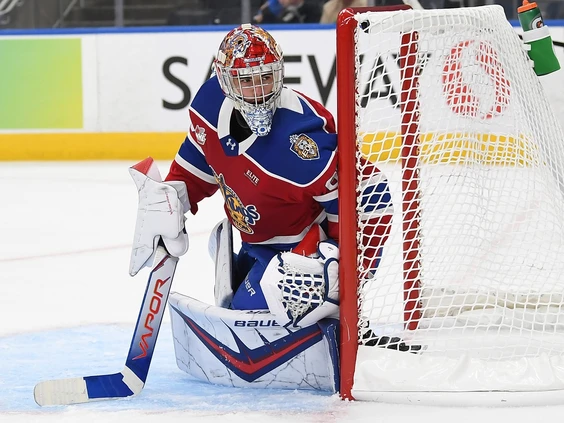
Photo: by Edmonton Oil Kings Hockey Club /LA Media
 By Arik KrauseEditor
Edited by Arik Krause
The Edmonton Oil Kings collected three of a possible four points during their opening weekend without several players who were still attending NHL camps.
Now, goaltender Parker Snell and forward KJ Sauer have returned to Edmonton.
Sauer gives the Oil Kings another sizeable forward who should immediately compete for a top-nine role. Snell’s return creates a more complicated question.
Who should start in goal?
Edmonton Used a Genuine Tandem Last Season
It would be easy to describe Snell as Edmonton’s returning starter after he was selected by the Columbus Blue Jackets and attended their training camp.
Last season’s workload does not support that conclusion.
Ethan Simcoe appeared in 38 regular-season games, posting a 24-9 record with a 2.93 goals-against average and an .888 save percentage. Snell played 33 games and finished 21-9-1 with a 2.74 goals-against average, an .895 save percentage and three shutouts.
Simcoe played five more games and earned three more victories. Snell produced the stronger individual percentages.
That is the statistical profile of a tandem, not a starter and backup.
Snell Strengthened His Case in the Playoffs
Snell’s strongest argument comes from what happened after the regular season.
He recorded a 2.22 goals-against average and a .924 save percentage across four playoff appearances. His biggest performance came in Game 6 against Saskatoon, when he stopped 37 shots during Edmonton’s double-overtime victory.
That performance kept Edmonton’s season alive and forced Game 7.
Simcoe still played an important role in the series. He appeared in three games and was given the net for the deciding game at Rogers Place. The Oil Kings ultimately lost 3-2 in overtime.
Snell’s playoff numbers were better, but Edmonton continued using both goaltenders when the season was on the line.
That history matters when projecting the crease this season.
Does Being Drafted Give Snell an Advantage?
It should give him an opportunity, but not an automatic starting position.
Columbus selected Snell 142nd overall in the fifth round of the 2026 NHL Draft. Blue Jackets assistant director of amateur scouting Trevor Timmins specifically praised Snell’s ability to read the game, his technique and the progress he made throughout last season.
Snell is now an NHL-affiliated prospect. Columbus will monitor his workload, development and technical progression closely.
That gives Edmonton another reason to ensure he receives meaningful starts. It does not mean the Oil Kings need to hand him the crease regardless of performance.
Simcoe has already made his own argument.
He stopped 41 of 42 shots in Edmonton’s opening-night victory over Red Deer. After also starting against Calgary, Simcoe finished the weekend with 67 saves on 72 shots, good for a .931 save percentage.
Taking the larger workload last season, earning the Game 7 start and opening this season with two strong performances should prevent Simcoe from simply being pushed into the backup position.
The Most Likely Outcome Is Another Competition
Snell’s return does not settle Edmonton’s crease. It reopens the competition.
Snell has the better 2025-26 rate statistics, the stronger playoff numbers and the added development expectations that come with being an NHL draft pick.
Simcoe has the larger previous workload, more regular-season wins and the early advantage this season after performing well in both opening-weekend games.
The Oil Kings do not need to make a permanent decision immediately.
The most reasonable projection is another tandem, at least through the early portion of the season. Simcoe has earned the opportunity to keep playing, while Snell will be given every chance to build upon his playoff run and take a larger share of the starts.
Whichever goaltender performs more consistently will eventually separate himself.
Sauer Adds Another Option Up Front
Sauer’s return is more straightforward.
The 6-foot-3, 203-pound forward was selected 136th overall by the Philadelphia Flyers after producing 25 points in 15 Minnesota high school games and five points in five USHL appearances.
His size, forechecking and ability to play through contact should help an Edmonton forward group that is still establishing its identity.
Sauer does not necessarily force an immediate major roster decision. Edmonton can rotate its younger forwards, adjust its lines and allow performance to determine who remains in the lineup.
Ta’amu Has Already Made His Return Count
Noa Ta’amu returned from Winnipeg Jets camp before Snell and Sauer and immediately stepped back into an important role on Edmonton’s blue line.
Ta’amu scored the tying goal against Calgary and provided the Oil Kings with a more composed presence defensively and in transition.
Following the game, head coach Jason Smith described Ta’amu as “stabilizing for us,” adding: “He can move the puck, he’s physical, he’s got a great stick in the defensive zone.”
That assessment explains why Ta’amu’s return matters beyond his goal against Calgary. Edmonton is relying on a young defensive group, and Ta’amu gives Smith a dependable option who can defend, move possession up the ice and play through contact.
With Ta’amu already back and Sauer and Snell now returning, the Oil Kings are beginning to resemble the team Edmonton expected to have entering the season.
The situation in goal remains the biggest question. Snell’s NHL draft status and strong playoff performance give him a legitimate opportunity to claim more playing time, but Simcoe’s larger workload last season and excellent opening weekend mean the crease has not automatically been handed over.
That competition, combined with Edmonton’s returning NHL camp players, should make the Oil Kings a deeper and more difficult team than the one that already collected three of four points during opening weekend.


2027 NHL Draft Watch: Brock Cripps, Artem Katsuro and Kayden Stroeder
 By Arik Krause · September 22, 2026
Hunter Aura Strikes in Overtime as Hitmen Defeat Oil Kings 4-3
By Arik Krause · September 20, 2026Changing of the Guard: Oil Kings Lose Major Pieces Ahead of 2026–27 Season
By Arik Krause · September 15, 2026