
Photo: Google
 By Arik KrauseEditor
Edited by Arik Krause
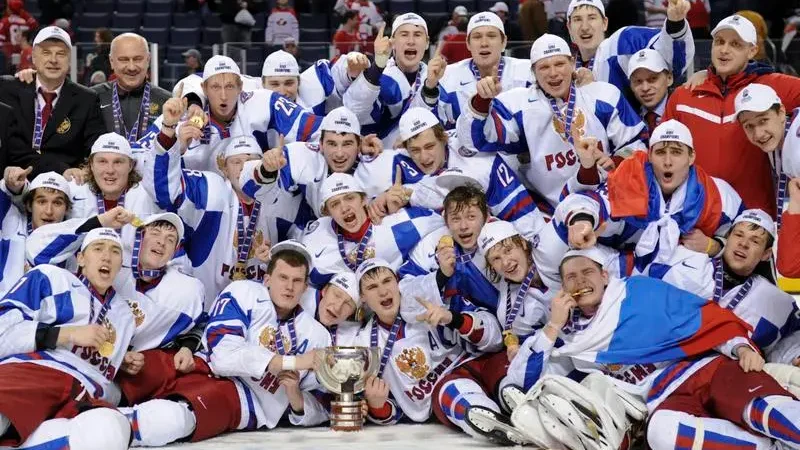
Russia’s successful appeal has reopened the door to the World Juniors. A hypothetical lineup featuring Ivan Ryabkin, Alexander Zharovsky and an intriguing younger generation shows why its return could change the tournament.
Russia’s return to international hockey has moved from speculation to an immediate challenge for the IIHF.
Following a successful appeal to the Court of Arbitration for Sport, Russia has been cleared to participate in the affected IIHF championships for the 2026–27 season, including the 2027 World Junior Championship in Edmonton and Red Deer.
The IIHF has acknowledged the ruling while maintaining its concerns about safety, security and the practical consequences of adding Russia to competitions already deep into their preparations. Tournament arrangements still need to be resolved, so a revised schedule or group placement should not be assumed.
For hockey fans, however, the decision brings a familiar question back into focus.
What would Russia actually bring?
There is enough talent available to make that a much more interesting conversation than simply adding another country to the draw. This hypothetical roster combines older eligible prospects with a younger generation that could become one of the tournament’s biggest attractions.
This is a projected lineup, not an announced Russian roster. All selections remain subject to eligibility confirmation, health, club release and the final participation arrangements.
The projected roster
Goaltenders
| Pyotr Andreyanov |
| Semyon Frolov |
| Yakov Kazantsev |
Defence
| Nikita Shcherbakov | Vladimir Shtyrkhunov |
| Kurban Limatov | Yaroslav Fedoseyev |
| Maksim Sokolovskii | Maxim Agafonov |
| Nikita Tyurin |
Forwards
| Egor Shilov | Ivan Ryabkin | Nikita Klepov |
| Alexander Zharovsky | Ilia Morozov | Nazar Privalov |
| Sergei Skvortsov | Viktor Fyodorov | Gleb Pugachyov |
| Daniil Prokhorov | Lavr Gashilov | Bogdan Yakushevsky |
| Alexei Vlasov |
Positions and combinations reflect our proposed deployment rather than confirmed national-team roles.
Ryabkin’s line could set the pace
The first combination would put Ivan Ryabkin between Egor Shilov and Nikita Klepov, giving Russia an appealing starting point for its offence.
Ryabkin would be one of the older eligible forwards and a natural candidate for major responsibility. Pairing him with Shilov would give the coaching staff two players capable of taking on important offensive assignments without concentrating every established name on the same unit.
Klepov would be the particularly significant addition.
His previous appearance for the United States at the Hlinka Gretzky Cup does not make his Russian participation something to assume automatically. His international eligibility would need to be confirmed, and his NHL situation adds a separate question about availability.
Although last time he was interviewed, he stated he would play for Russia if they were eligible.
Under those conditions, this would be a line worth testing early in camp. The objective would be to establish a unit that can create consistently while leaving enough talent elsewhere to prevent opponents from focusing on a single matchup.
Zharovsky, Morozov and Privalov make the depth more convincing
The second line might be the strongest argument for taking this projected team seriously.
Alexander Zharovsky, Ilia Morozov and Nazar Privalov would give Russia another combination deserving substantial offensive opportunities. That changes the challenge for opposing coaches. Assigning a preferred defensive pairing to Ryabkin’s line would still leave another dangerous group coming over the boards.
Zharovsky would be one of our central offensive selections. Morozov would get the opportunity to anchor this combination through the middle, while Privalov would bring one of Russia’s most intriguing younger prospects into a prominent role.
Privalov’s inclusion would also give the tournament another significant draft storyline.
There is a balance to strike with younger players at the World Juniors. Reputation alone should not guarantee a top-six assignment, but age should not prevent a player from earning one either. In this projection, Privalov would get that opportunity alongside teammates capable of sharing the responsibility.
It would be a meaningful test against older opponents, particularly once the tournament reaches games where time and space become harder to find.
The third line would deserve a real offensive role
A combination of Sergei Skvortsov, Viktor Fyodorov and Gleb Pugachyov should not be treated as filler beneath the first two units.
Our preference would be to give this group genuine offensive minutes and an opportunity to influence games. A team with this much potential up front would gain little by asking its third line only to survive until the leading forwards return.
Skvortsov would be another younger selection, making his adjustment to the tournament an important part of the story. Fyodorov and Pugachyov would provide additional options around him, with room for the coaching staff to change combinations if another partnership develops in camp.
There would be no need to preserve the projected order at all costs. The value of this forward group would be the number of alternatives available if a line struggles.
Prokhorov gives the fourth line options
Daniil Prokhorov, Lavr Gashilov and Bogdan Yakushevsky would complete the initial four-line arrangement, with Alexei Vlasov as the extra forward.
The important decision here would concern usage. Calling a unit the fourth line should not settle its ice time before the tournament begins.
Prokhorov would be a candidate to move higher if his performances warrant it. Gashilov would have an opportunity to establish a dependable role through the middle, while Yakushevsky and Vlasov would give the staff further choices as it works out the best combinations.
Penalty-killing assignments and late-game defensive responsibilities would need to be earned in camp. Those roles should not simply be handed to whichever players appear lowest on a projected lineup.
The defence looks different with Limatov and Sokolovskii involved
A blue line featuring Nikita Shcherbakov, Kurban Limatov and Maksim Sokolovskii would give this projection a stronger foundation than a selection built mainly from the current domestic U20 roster.
The proposed first pairing puts Shcherbakov alongside Vladimir Shtyrkhunov. That would be an ambitious assignment for Shtyrkhunov, a 2009-born defender, and one of the combinations we would watch most closely in preparation.
The question would be whether the pairing can handle difficult minutes together, rather than whether the names look attractive on paper.
Limatov and Yaroslav Fedoseyev would form the second combination, followed by Sokolovskii and Maxim Agafonov. Nikita Tyurin would provide the seventh option.
That arrangement would spread several of the more prominent defensive candidates across three pairings. It would also give the staff flexibility to redistribute minutes if a younger player needs a more sheltered introduction or a particular partnership struggles.
Sokolovskii’s size would be an obvious feature, but Russia would still need the entire group to move the puck efficiently. Against strong forechecking teams, getting out of the defensive zone cleanly could determine how often those promising forwards get to attack.
Andreyanov and Frolov would headline the crease
Pyotr Andreyanov and Semyon Frolov would be our leading candidates for the starting job, with Yakov Kazantsev completing the trio.
Andreyanov would enter our projection with the opportunity to claim the first assignment, but Frolov would make it a competition rather than a predetermined decision.
Kazantsev would be the longer-term selection. Born in November 2009, he would turn 17 before the tournament, making him considerably younger than the two 2007-born goaltenders.
Including him would give Russia a younger option without requiring him to carry the immediate workload. Whether that is the best use of the third position would depend on his form and how the staff assesses its alternatives closer to December.
Enough talent to change the medal conversation
This projected roster would make Russia a credible medal contender.
The forward combinations would offer several potential sources of offence. The defence would include established prospect names alongside younger candidates, and the goaltending group would provide more than one plausible starting option.
That still would not justify declaring Russia a favourite before it has assembled a camp.
There are unresolved participation arrangements, individual eligibility and release questions, and the practical task of turning a collection of players into a functioning tournament team. Those details matter in an event where one poor performance in an elimination game can end a medal bid.
But the talent makes the possibility compelling.
If Russia arrives in Alberta with a lineup resembling this one, they could shake up the medal rounds in their return to international competition.

DUB Daily: Stephens goes Kookoo, Kivistö returns to Liiga, and more!
 By Paul Figler · October 30, 2026
DUB Daily: Blades & Wild swing a trade, Giants sign Humeniuk, and more!
By Paul Figler · October 29, 2026
Three Up, Three Down: Penticton Finds Its Punch as Trouble Builds in Moose Jaw
 By Arik Krause · October 28, 2026