
 PG 0
PG 0 SEA 8
SEA 8 TC 2
TC 2 SPO 3
SPO 3 PA 2
PA 2 SAS 5
SAS 5 SC 2
SC 2 REG 6
REG 6 MH 5
MH 5 EDM 2
EDM 2 VAN 4
VAN 4 RD –
RD – LET –
LET – BDN –
BDN – POR –
POR – KAM –
KAM – KEL –
KEL – VIC –
VIC – PEN –
PEN – WEN –
WEN – MJ –
MJ – CGY –
CGY –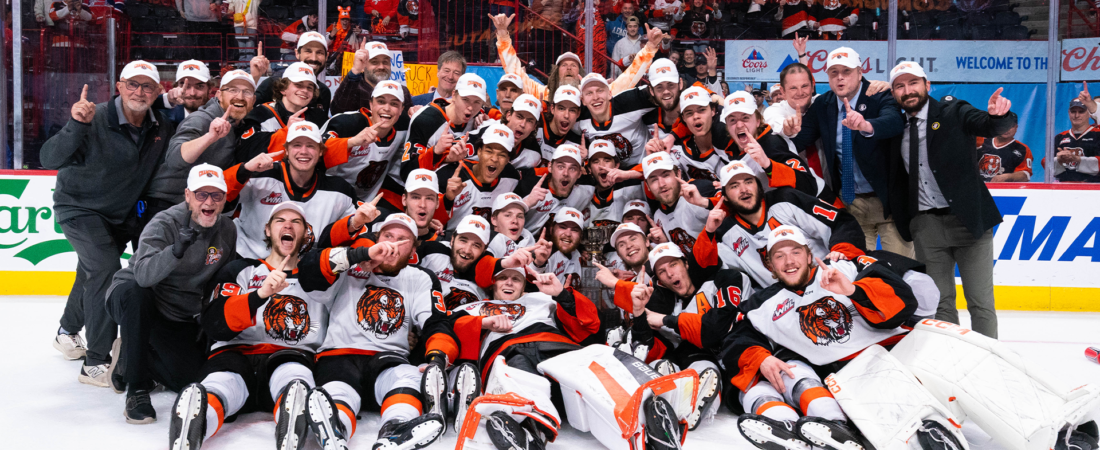
Photo: CHL.ca
 By Arik KrauseEditor
Edited by Arik Krause
The Medicine Hat Tigers have never needed the largest market, newest arena or richest history in Canadian junior hockey to remain relevant.
They have simply continued developing players and winning.
Since entering the Western Hockey League for the 1970–71 season, the Tigers have captured six WHL championships, appeared at six Memorial Cups and won Canadian junior hockey’s ultimate prize twice.
Their championship years span more than half a century: 1973, 1987, 1988, 2004, 2007 and 2025.
That longevity is what separates Medicine Hat from a temporary dynasty. Rosters change, coaches leave and the direction of junior hockey continues to evolve, but the Tigers have repeatedly found a way to build another contender.
The latest version may have produced the organization’s most impressive concentration of NHL talent yet.
The Tigers Became Champions Almost Immediately
Medicine Hat joined the league as an expansion franchise in 1970 and required only three seasons to win its first championship.
The 1972–73 Tigers were led by Tom Lysiak and Lanny McDonald, two players who would become foundational figures in franchise history.
Lysiak was selected second overall by the Atlanta Flames in the 1973 NHL Draft. McDonald was taken fourth overall by the Toronto Maple Leafs.
Before beginning their NHL careers, they helped establish the expectations that would follow every Tigers team that came after them.
Medicine Hat advanced to its first Memorial Cup in 1973. The Tigers did not win the tournament, but reaching the national championship only three years after the franchise was established represented an extraordinary beginning.
Lysiak and McDonald remain two of the greatest players ever developed by the organization. Their No. 9 and No. 8 jerseys have both been retired by the Tigers, and both were named among the WHL’s top 50 players of all time.
The first great Medicine Hat team established that the franchise could identify and develop elite talent. The teams that followed proved it was not an isolated accomplishment.
Back-to-Back Memorial Cups Created a Lasting Legacy
The greatest period in Tigers history arrived during the late 1980s.
Medicine Hat captured consecutive WHL championships in 1987 and 1988 before winning the Memorial Cup in both seasons. The Tigers remain the only Alberta-based WHL franchise to win back-to-back Memorial Cups and are one of only a small number of teams in tournament history to repeat as champions.
The 1987 Tigers defeated the Oshawa Generals 6-2 in the championship game. Wayne McBean was named tournament MVP, while Mark Fitzpatrick earned recognition as the Memorial Cup’s top goaltender.
Medicine Hat returned the following year and successfully defended its title.
That second championship roster included Trevor Linden, Rob DiMaio, Mark Pederson, Dean Chynoweth, McBean and Fitzpatrick. DiMaio was named tournament MVP, while Fitzpatrick was again recognized as the top goaltender.
The talent on those teams translated directly to the NHL Draft.
McBean was selected fourth overall in 1987. Chynoweth went 13th, Fitzpatrick was taken 27th and DiMaio was selected later in the same draft.
One year later, the Vancouver Canucks selected Linden second overall.
The championship banners remain the most visible reminder of those teams, but their real legacy was the standard they established. Medicine Hat was no longer simply a successful small-market junior club. It had become one of the defining organizations in the Canadian Hockey League.
Medicine Hat Rebuilt Another Champion in 2004
Sixteen years passed before the Tigers returned to the top of the WHL.
The 2003–04 roster featured another collection of players who would eventually reach professional hockey, including Cam Barker, Clarke MacArthur, Stefan Meyer, Ryan Hollweg, Darren Reid, Kris Russell and goaltender Kevin Nastiuk.
Medicine Hat finished first in the Central Division before producing a 16-4 playoff record. The Tigers swept the expansion Everett Silvertips in the WHL Championship Series, with Nastiuk recording consecutive shutouts during the final.
Barker was selected third overall by Chicago in the 2004 NHL Draft, becoming the highest-drafted Tiger since Rob Niedermayer went fifth overall in 1993.
The Tigers did not win the Memorial Cup that season, but the championship created the foundation for another dominant stretch.
Medicine Hat finished first in the Central Division in four consecutive seasons from 2003–04 through 2006–07. Russell developed from a rookie on the 2004 championship team into one of the best defencemen in junior hockey.
By 2007, the Tigers were ready to win again.
The 2007 Team Extended the Championship Standard
Medicine Hat’s 2007 roster was led by Russell, Darren Helm, Derek Dorsett, David Schlemko, Tyler Ennis and goaltender Matt Keetley.
Russell was named the WHL Player of the Year and CHL Defenceman of the Year after producing one of the strongest seasons by a defenceman in league history. Helm provided speed and scoring, while Dorsett and Schlemko added the competitive depth that would later allow both players to build lengthy professional careers.
The Tigers met the Vancouver Giants in a memorable seven-game WHL Championship Series.
Medicine Hat captured the title in double overtime after a game that stretched deep into the night. The win sent the Tigers to their fifth Memorial Cup appearance.
Vancouver ultimately defeated Medicine Hat in the Memorial Cup final, but the Tigers had secured their fifth WHL championship and their third league title in 20 seasons.
More importantly, the 2004 and 2007 teams proved the organization could recreate its earlier success with a completely different generation.
The Latest Rebuild Produced Another WHL Champion
The Tigers’ most recent rise began from a much different position.
Medicine Hat finished near the bottom of the Central Division in 2021–22 and 2022–23. Rather than chasing short-term improvement, the organization assembled a young core and allowed it to develop together.
That group eventually included Gavin McKenna, Cayden Lindstrom, Andrew Basha, Hunter St. Martin, Tomas Mrsic, Bryce Pickford and several other future NHL draft picks.
By 2023–24, the Tigers had returned to the playoffs as a dangerous young team. One year later, they became WHL champions.
Medicine Hat defeated the Spokane Chiefs in five games to capture the 2025 Ed Chynoweth Cup. The championship roster included eight players who had already been drafted by NHL organizations, along with several others eligible for the upcoming drafts.
The Tigers then advanced through the Memorial Cup round robin with a perfect 3-0 record, including a 3-1 victory over the London Knights. Medicine Hat returned to the championship game for the fourth time in franchise history before London won the rematch 4-1.
The result prevented Medicine Hat from adding a third Memorial Cup, but reaching the national final reinforced the organization’s place among junior hockey’s most accomplished programs.
The Tigers now have six Memorial Cup appearances and 15 tournament victories. Only a small group of CHL organizations have appeared at the event more often.
The Recent NHL Draft Run Is Remarkable
Medicine Hat’s current run of NHL talent may be even more impressive than its championship total.
Four Tigers were selected in the 2024 NHL Draft, the highest total among WHL clubs.
Cayden Lindstrom was selected fourth overall by Columbus. Andrew Basha went 41st to Calgary, Tomas Mrsic was selected 113th by St. Louis and Hunter St. Martin went 193rd to Florida.
Bryce Pickford became the next Tiger selected when Montreal drafted him 81st overall in 2025.
The 2026 NHL Draft then produced five more Medicine Hat selections.
Gavin McKenna went first overall to Toronto, becoming the first Tigers-developed player selected with the opening pick. Liam Ruck was taken 22nd by Pittsburgh, his twin brother Markus followed at 39th, Vancouver selected Yaroslav Bryzgalov 97th and Columbus drafted Jonas Woo 185th overall.
Medicine Hat led every WHL organization with five selections in that draft.
That gives the Tigers 10 NHL draft selections across the 2024, 2025 and 2026 drafts.
The organization now lists 127 drafted players across its 55-year history. That group includes Lysiak, McDonald, Linden, Chris Osgood, Rob Niedermayer, Jay Bouwmeester, Joffrey Lupul, Barker, MacArthur, Russell, Helm, Cole Sillinger and McKenna.
Many organizations experience successful draft cycles. Medicine Hat has continued producing NHL players across several completely different eras.
Development Has Remained the Constant
The Tigers’ success cannot be explained entirely by high draft selections.
Lindstrom was a third-round WHL Prospects Draft pick before becoming the fourth player selected in the NHL Draft.
McKenna entered the WHL as one of the most talented players in his age group, but Medicine Hat still provided the environment in which he became a 129-point scorer, WHL Player of the Year, CHL Player of the Year and eventual first-overall NHL selection.
The Ruck twins developed from promising young forwards into first- and second-round NHL draft picks. Pickford became an NHL selection and a championship captain. Players such as St. Martin and Mrsic developed into professional prospects without entering the league carrying the profile of certain NHL draft choices.
That distinction matters.
Recruiting talented players is part of building a successful junior organization. Helping those players improve, placing them in meaningful roles and surrounding them with complementary talent is what turns potential into championships.
Medicine Hat has repeatedly succeeded at both.
The Pipeline Has Not Stopped
The players selected between 2024 and 2026 may be gone or approaching the end of their WHL careers, but the next group is already forming.
Liam and Markus Ruck remain central pieces of the Tigers’ offence. Bryzgalov brings NHL-drafted skill, while younger players such as Noah Davidson and Shaeffer Gordon-Carroll have already entered the 2027 NHL Draft conversation.
Medicine Hat has also continued adding talent from outside its traditional draft pool. International additions and trades have supplemented the players selected and developed internally, creating rosters with skill, depth and competition at nearly every position.
The names change, but the organizational pattern remains recognizable.
The Tigers identify talent early, give young players opportunities, develop them in significant roles and build around the group when its competitive window arrives.
Medicine Hat’s Dominance Is Measured in Generations
The Tigers have not dominated every season of their existence.
There have been rebuilding years, early playoff exits and long stretches between championships. That is unavoidable in junior hockey, where the best players eventually graduate and roster cycles move quickly.
Medicine Hat’s dominance is better measured by its ability to return.
The franchise won its first WHL championship in 1973, added consecutive Memorial Cups in 1987 and 1988, built another championship group in 2004, won again in 2007 and returned to the national final as WHL champion in 2025.
Its list of NHL alumni stretches from Lysiak and McDonald to Linden, Osgood, Bouwmeester, Russell and McKenna.
The Tigers have won with different owners, executives, coaches, playing styles and generations of athletes. Through all of those changes, player development and championship expectations have remained part of the organization’s identity.
That is what makes Medicine Hat one of the WHL’s defining franchises.
The Tigers are not remembered because of one championship team or one exceptional draft class.
They are remembered because they keep building another one.


Tigers’ Depth and Special Teams Sink Oil Kings in 5-2 Loss
 By Arik Krause · September 27, 2026
5 Players to Watch in the WHL (October 2026)
 By Keenen Kanda · September 24, 2026
Medicine Hat Tigers Return the WHL’s Most Dangerous Duo for 2026–27
By Arik Krause · September 17, 2026